| |

|
|

Windspeed Limited (trading as Vector Instruments)
|
|
|
|
|
|
|
|
|
|
| GUIDANCE ON SITING OF ANEMOMETERS AND WINDVANES |
|
|
Note: This guidance applies to general applications. In the case of wind farm site assessment or wind turbine power-performance testing, please refer to the guidance given in the IEA-11 and IEC61400-12-1 standards.
See also: Obtaining the highest accuracy wind speed measurements.
IDEAL SITE
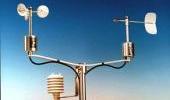
In order to obtain the best measurements of wind speed and direction, the sensors should be supported in such a way that neither the supporting poles nor the other sensor, obstruct the air flow to the sensor. Due to increased wind speed with height and the increase of turbulence close to the ground, a standard height of 10 metres is used. The site should be level and have no large obstructions, buildings etc, within a radius of 300 metres.
TYPICAL URBAN SITE
The average urban site will contain many obstacles to wind flow, which will generally have the affect of reducing the average wind speeds and increasing localised turbulence levels. Therefore, a compromise has to be reached, taking into account as many as possible of the following points.
- Seek an area where all the buildings are of a similar height and place the sensors on the roof of the highest.
- Position sensors on the prevailing wind side of the site (usually on the west or south-west side in the case of the UK).
- The sensors should be mounted on the top of the mast, a minimum of 500 mm apart.
Theoretically the sensors should be mounted at a height of 1.5 times the height of the building. However, on tall buildings, satisfactory results can often be obtained using a mast/pole mounted on the roof on the prevailing wind side of the building which positions the wind instruments 3 to 5 metres higher than any objects on the roof (or nearby treetops etc). Any mast/pole may need to be fitted with stays/guys to prevent the pole/mast and wind instruments vibrating in high/turbulent wind conditions. On very large buildings, additional sensors mounted on the other side(s) of the building may also be required.
If the sensors are to be mounted on a boom, part way up a tower or mast, then the boom should be at least twice as long as the minimum diameter or diagonal of the tower. The boom should be positioned on the prevailing wind side of the tower.
Do not cut the sensor cables to the exact length when initially installing the system, as sometimes, moving the sensors by only one metre, can make the difference between accurate and inaccurate readings.
Ensure that the sensors are positioned as far away as possible from any heat output or air turbulence caused by extractor fans.
Ensure that the sensors are in a secure position, where they can not be easily vandalised.
SPECIAL REQUIREMENTS.
On occasions the localised wind speed and direction is required rather than the general wind conditions. In these cases the sensors should be mounted as near as possible to this localised position. For example :-
- If there is concern that people may be blown over by strong winds, due to the tunnel effect between two buildings, then the sensors should be mounted between the buildings, preferably at the height of a human being.
- If there is concern about the possible effect of an emission on an area of population to the north of a factory, then the sensors should be placed (for example) on the south side of the factory, to ensure the best possible results during southerly winds.
Disclaimer: Windspeed Ltd. (Vector Instruments) have provided this information in good faith and whilst every effort has been made to eliminate errors, Vector Instruments and any employees thereof cannot be held responsible for any loss, damages, consequential loss or injury which can be attributed to the use of any information or claims made in this document. These notes are intended for guidance only, and therefore Vector Instruments can not be held responsible for any unrepresentative readings acquired after following these guide lines. In the UK, further information on siting can be obtained from your local Weather Centre, details of which can be obtained by phoning 01344 856832.
|
| [Back...] |
|
|
|
|
|
Windspeed Limited (trading as Vector Instruments),
113 Marsh Road, RHYL, North Wales, LL18 2AB, United Kingdom
Tel: +44 (0) 1745 350700 Fax: +44 (0) 1745 344206
Email: sales@windspeed.co.uk
|
|
Website design and content is copyright (c) 2003-2024 Windspeed Limited (unless otherise stated). All trademarks are acknowledged.
|
|
